BirdsEye
Vision-based autonomous rover, sim-to-real
- Role
- Team Lead & Lead Programmer
- Timeline
- Spring 2026 · ECE 4524
- Tags
- Robotics · ML · Embedded · Research
100%
sim-to-real success rate (50/50 episodes)
22-dim
state vector from vision alone
Problem
Autonomous navigation usually leans on expensive per-robot sensor suites, with cost scaling linearly for every robot added. BirdsEye asks whether a single cheap overhead camera and a learned policy can drive a rover to a goal in real time — a proof of concept that scales to settings like warehouses.
Approach
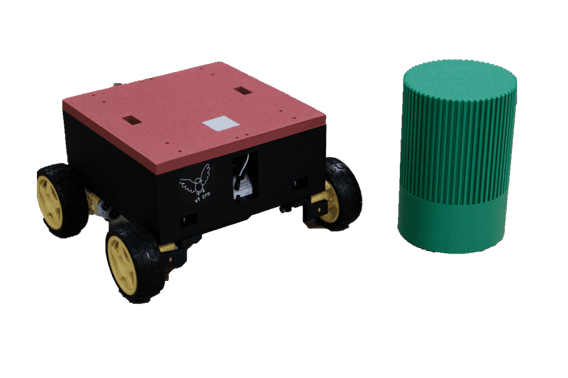
Train a Double Deep Q-Network in a calibrated PyGame simulation, then transfer the policy to a 3D-printed RC rover. Since a real system has no ground-truth state, a computer-vision pipeline reconstructs the same 22-dimensional state vector the agent trained on — isolating the rover with HSV color masks, fitting a rotated bounding box, recovering heading from a tape marker, and locating the target — and feeds it to the model, which issues discrete actions over Bluetooth.
What I built
- Led a 5-person team as Team Lead and Lead Programmer — owning the PyGame reinforcement-learning environment, the Double DQN, and the integration of the trained model into the physical rover.
- Computer-vision perception pipeline — dual-range HSV masking, contour and min-area-rect fitting, and a white-tape heading marker reconstruct a 22-dimensional state (car corners, heading, target position, wall distances) from a raw 1920×1080 camera frame.
- State-space generation: designed the normalized 22-feature state representation and reward ruleset that let a compact MLP (256-256-128) learn navigation without raw pixels or convolutions.
- Double DQN trained over ~4000 episodes with experience replay, a target network, epsilon-greedy exploration, Huber loss, and gradient clipping — decoupling action selection from evaluation to curb Q-value overestimation.
- Sim-to-real transfer: a calibration script aligned simulation linear/angular velocities to the rover's real motion, and temporal heading smoothing plus a 2.5° deadband stabilized closed-loop control on physical hardware (Arduino Uno, L289n driver, HC-05 Bluetooth).
Result
A 100% success rate across 50 real-world episodes (average reward 108.97, ~26.6 steps to target) with smooth, collision-free trajectories — confirming that a structured state representation plus classical vision can bridge the sim-to-real gap on low-cost hardware.
Media